01 The Pain Point: The "Mismatch" Dilemma
For asset managers and O&M (Operation and Maintenance) providers, the real headache isn't just that panels are getting older—it’s that when they break, they are becoming increasingly impossible to replace. This "Mismatch Problem" is one of the solar industry's most acute pain points, and solving it is the key to maintaining profitability and sustainability.
Imagine a commercial rooftop solar plant installed in 2013. It runs on 250W poly-crystalline modules, which were the industry standard at the time. A storm damages 20 of these panels.
The asset manager now faces a critical problem: Those panels no longer exist.
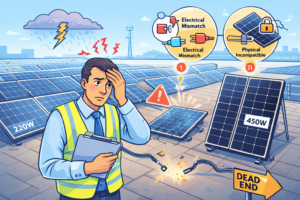
Manufacturers have shifted production to larger formats (like 182mm or 210mm cells), higher wattages (400W–600W+), and different electrical characteristics. You cannot simply plug a modern 450W panel into an old string of 250W panels. Doing so causes:
* Electrical Mismatch: The new panel’s current and voltage curves will differ from the old ones, causing the entire string to operate at the level of the weakest link (or worse, damaging the inverter).
* Physical Incompatibility: Modern panels are physically larger. They often won't fit the existing clamping zones or racking rails designed for older, smaller modules.
This leaves owners with a "stranded asset" dilemma: Do they scrap the whole working system just to fix a few broken panels? Or do they leave the system running at reduced capacity with open circuits?
02 The Data: Why This Matters Now
The scale of this issue is backed by significant industry data.
1. The Degradation Clock is Ticking
According to the National Renewable Energy Laboratory (NREL), the median degradation rate for photovoltaic systems is approximately 0.5% per year. While this proves solar is durable, it also means that a 10-year-old system is naturally producing about 5-8% less power than when new. If you add unmatched replacement panels to this mix, the "mismatch loss" can accelerate this yield drop significantly, harming ROI.
2. The Looming Waste Volume
The International Renewable Energy Agency (IRENA) has projected that by the 2030s, the world will see a surge in PV waste, potentially reaching huge volumes by 2050. However, a significant portion of "waste" today isn't end-of-life panels—it is premature scrapping of repairable systems simply because compatible spares couldn't be found.
By finding the right replacement panels, we extend the life of the entire facility, deferring waste and aligning with the circular economy.
03 The Solution: Strategic Replacement & Repowering
The solution lies in specialized procurement. The industry needs a shift toward "Intelligent Repowering" and "Legacy Compatibility Sourcing."
Using replacement panels that are specifically matched to legacy specifications (or using modern modules with electrical optimizers that allow them to mimic legacy behavior) offers three massive benefits:
1. Restored Yield: Replacing damaged units brings the string back to full voltage, instantly restoring the lost 20-30% of generation capacity.
2. Avoided CAPEX: Sourcing compatible spares is a fraction of the cost of a "Full Repowering" (ripping out the whole system and starting over).
3. Safety & Compliance: Using electrically matched panels ensures the system stays within the inverter's safety voltage windows, reducing fire risks associated with mismatched loads.
04 How GBP K.K. Bridges the Gap
At GBP K.K., we understand that a solar plant is a long-term financial asset. We specialize in identifying and sourcing high-quality modules that solve the mismatch problem. Whether it involves sourcing specific dimensions to fit existing rails or providing technical consultation on mixing panel generations safely, we act as the bridge between the "old fleet" and new technology.
Don't let a few broken panels compromise your entire power plant. Contact GBP K.K. today to discuss how we can restore your system's performance.