
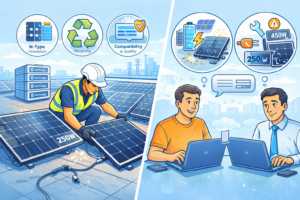
01 Solar Keeps Growing — But the Nature of Growth Is Changing
Global solar installations continued to surge in 2025, with record deployments reported across multiple regions. In the first half of 2025, the world installed roughly 380 GW of new solar capacity, a 64% increase year-on-year.
However, the growth trajectory is evolving. Research from BloombergNEF and S&P Global Energy forecasts a small year-on-year decline in solar additions in 2026, driven by policy changes and market adjustments in China and the U.S.
This signals not stagnation, but maturation — a shift from rapid capacity growth to strategic deployment, integration, and quality optimization.
02 Solar Is Hitting New Milestones — and Asking New Questions
Across Reddit solar communities, users are noticing major shifts:
🔹 Subscribers shared that solar power generated 10% of global electricity in April 2025, surpassing nuclear for the first time.
🔹 Other posts anticipate annual global solar deployment could approach nearly 700 GW in 2025 — though some note lower growth rates in major markets.
These discussions reflect both excitement about solar’s expanding role in electricity systems and a recognition that the landscape is evolving — from installation volume to system performance and resilience.
03 Solar Panel Replacement & “Mismatch Problems” Are Hot Topics Online
One of the most active threads in professional and enthusiast forums today is solar panel replacement — driven by the fact that many systems installed under early FIT programs are now aging or degrading faster than expected.
Redditors and industry pros alike are pointing out the so-called “mismatch problem”: modern high-efficiency panels like TOPCon or HJT differ in size, power output, and electrical characteristics from older modules, making it difficult to replace single damaged panels without impacting performance or inverter compatibility.
This conversation echoes a larger industry reality — renewable assets are now aging into a phase where replacement, compatibility, and lifecycle management matter as much as initial installation.
For companies like GBP K.K., specializing in replacement panels engineered for compatibility and performance, this is a major market opportunity.
04 Solar + Storage Integration Is No Longer Optional — It’s Strategic
One of the biggest shifts in solar deployment patterns is the rapid pairing of PV systems with battery storage. Industry research shows that in 2025, a growing share of new solar installations include significant battery integration — helping address intermittency, enhance grid flexibility, and multiply value.
This trend increases demand for replacement and upgrade components that are compatible not just with solar modules but with integrated system architectures, including storage and power electronics.
05 Technology Innovation Continues — But So Does Lifecycle Complexity
Advanced technologies are shaping how solar systems are designed and maintained:
✔ N-type modules (TOPCon, HJT) are becoming mainstream due to their higher efficiency and longer lifespans.
✔ Perovskite and tandem cells are nearing commercial viability with record efficiencies approaching 30%+.
✔ Bifacial and next-gen panel formats boost overall system output.
But with innovation comes complexity — especially in a market where older systems are still operating alongside cutting-edge panels and storage. This complexity makes compatibility-focused replacement solutions a high-value differentiator.